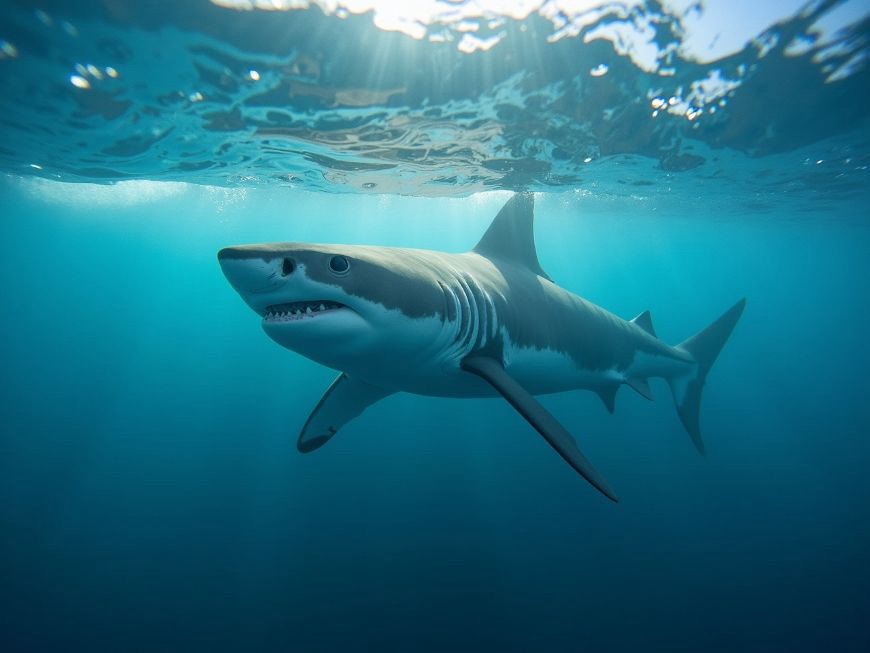
A massive great white shark named Contender has just been detected off Cape Breton Island, and marine researchers say it’s no ordinary visitor. Weighing an estimated 1,653 pounds and measuring 13.8 feet, Contender is the largest male white shark ever tagged in the Western North Atlantic, and he’s back in Canadian waters.
When and where Contender appeared
According to the ocean-tracking organization OCEARCH, Contender was first tagged in January 2025 about 45 miles off the Florida–Georgia coast. Since then, his satellite tag has recorded thousands of kilometres of migration along the U.S. East Coast and into Atlantic Canada.
Most recently, OCEARCH confirmed multiple pings between October 27 and 29, 2025, locating Contender off Cape Breton’s eastern coastline. Researchers say roughly 88 percent of sharks tagged in the U.S. Southeast migrate to Atlantic Canada during the warmer months, making these waters a crucial part of their life cycle.
Why Contender’s journey matters
Contender isn’t just a social-media headline, he’s a scientific breakthrough. Mature male white sharks are rarely studied this closely, so every ping provides valuable information about migration routes, feeding grounds, and ocean health.
Experts believe Contender’s presence highlights several key points:
- Healthy seal populations in the Gulf of St. Lawrence likely attract apex predators.
- Cooler northern waters offer ideal feeding conditions through fall.
- His movements could reveal important breeding or migratory corridors essential for conservation planning.
What OCEARCH scientists are learning
Contender’s satellite tag transmits data on location, dive depth, and temperature, allowing researchers to analyze seasonal behaviour and habitat preferences. The tag is expected to last up to five years, offering unprecedented insight into how these massive fish navigate the North Atlantic.
Scientists emphasize that Contender’s journey underscores the ecological richness of the region and the need for continued ocean-monitoring programs across Nova Scotia and the Gulf of St. Lawrence.
Atlantic Canada: a great white hotspot
Over the past decade, OCEARCH has recorded dozens of great white sharks frequenting Atlantic Canada each summer and fall. These include well-known names like Ironbound, Scotty, and now Contender. Their growing presence indicates thriving marine ecosystems, particularly around Cape Breton, Nova Scotia, Prince Edward Island, and the Bay of Fundy.
Contender’s arrival also brings attention to Cape Breton’s unique coastal environment, where rugged cliffs, rich biodiversity, and deep-water channels create prime hunting and migratory zones for large marine predators.
What’s next for Contender
Researchers will keep monitoring Contender’s movements via the OCEARCH Global Shark Tracker, which updates publicly whenever a tagged shark surfaces long enough to send a signal. You can follow his live path on OCEARCH.organd see whether he continues north into the Gulf or begins his return journey south.
As OCEARCH scientist Bob Hueter put it in a recent update:
“Contender helps us understand how these apex predators connect entire ecosystems. His size and maturity make him one of the most important sharks we’ve ever studied.”
About OCEARCH
OCEARCH is a non-profit marine research organization that tags and tracks apex predators worldwide. Its goal is to collect open-source data to support ocean conservation and improve understanding of marine life migration patterns.
Key Takeaways
- Contender is the largest male great white shark ever tagged.
- He recently pinged off Cape Breton Island, Nova Scotia.
- His migration provides crucial data for marine conservation.
- Atlantic Canada continues to be a hotspot for great white activity.
- Follow live updates on OCEARCH.org.

Leave a Reply